Join here for free stuff:

Friday, 16 November 2007

Crater From 1908 Russian Space Impact Found

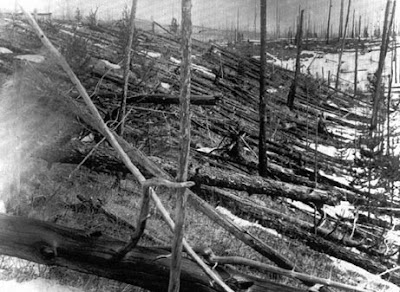
Almost a century after a mysterious explosion in Russia flattened a huge swath of Siberian forest, scientists have found what they believe is a crater made by the cosmic object that made the blast.

The crater was discovered under a lake near the Podkamennaya Tunguska River in western Siberia, where the cataclysm, known as the Tunguska event, took place on June 30, 1908, a ball of fire exploded about 6 miles (10 kilometers) above the ground in the sparsely populated region, scientists say. The blast released 15 megatons of energy—about a thousand times that of the atomic bomb dropped on Hiroshima—and flattened 770 square miles (2,000 square kilometers) of forest. Since then many teams of scientists have combed the site, but none was able to find any fragments of an object, like a rocky asteroid or a comet, that might have caused the event. In their new study, a team of Italian scientists used acoustic imagery to investigate the bottom of Lake Cheko, about five miles (eight kilometers) north of the explosion's suspected epicenter. "When our expedition [was at] Tunguska, we didn't have a clue that Lake Cheko might fill a crater," said Luca Gasperini, a geologist with the Marine Science Institute in Bologna who led the study. "We searched its bottom looking for extraterrestrial particles trapped in the mud. We mapped the basin and took samples. As we examined the data, we couldn't believe what they were suggesting. "The funnel-like shape of the basin and samples from its sedimentary deposits suggest that the lake fills an impact crater," Gasperini said.


A "Soft Crash"

The basin of Lake Cheko is not circular, deep, and steep like a typical impact crater, the scientists say. Instead it's elongated and shallow, about 1,640 feet (500 meters) long with a maximum depth of only 165 feet (50 meters). Gasperini's team says that the basin's unusual shape is the result of a fragment thrown from the Tunguska explosion that plowed into the ground, leaving a long, trenchlike depression. "We suggest that a 10-meter-wide [33-foot-wide] fragment of the object escaped the explosion and kept going in the same direction. It was relatively slow, about 1 kilometer a second [0.6 mile a second]," Gasperini said. The lake is located along the most probable track of the cosmic body, he added, which likely made a "soft crash" in the marshy terrain. "It splashed on the soft, swampy soil and melted the underlying permafrost layer, releasing CO2 [carbon dioxide], water vapor, and methane that broadened the hole, hence the shape and size of the basin, unusual for an impact crater. "Our hypothesis is the only one that accounts for the funnel-like morphology of Lake Cheko's bottom," he added. In a previous expedition, Russian scientists studied Lake Cheko and concluded that it had formed before 1908, indicating that it was not formed by the Tunguska event. The team had measured sediments on the bottom of the lake and determined that the deposits were accumulating there at about 0.4 inch (1 centimeter) a year. This suggested that Lake Cheko was several centuries old. But Gasperini's team argues that the older deposits found by the Russians were already there when the explosion took place. "We found evidence that only the topmost, one-meter-deep [three-foot-deep] layer of debris actually came from the inflowing river," Gasperini said. "[The] deeper sediments are deposits that predate 1908. They were the target over which the impact took place, so Lake Cheko is only one century old." The team's findings are based on a 1999 expedition to Tunguska and appeared in the August issue of the journal Terra Nova.
Asteroid or Comet?

William Hartmann, senior scientist of the Planetary Science Institute in Tucson, Arizona, said the new findings are compelling but do not address all of the lingering questions about the event. "It's an exciting result that might shed new light on the Tunguska explosion," he said. "Certainly it warrants new studies of the area. "But it raises a question in my mind: If one large fragment hit the ground, we would normally expect thousands of smaller fragments also to hit the ground along the path, and many searches have failed to find such meteorite fragments. So, why no smaller pieces?" Finding fragments from the explosion is considered key to determining what kind of object made the impact. An asteroid would probably leave some remains, while a comet might be annihilated in the blast, Hartmann said. "Our crater hypothesis is consistent with both possibilities," Gasperini said. "If the body was an asteroid, a surviving fragment may be buried beneath the lake. If it was a comet, its chemical signature should be found in the deepest layers of sediments." Gasperini and his colleagues are planning to go back to Siberia next year to search for more, and perhaps more conclusive, clues to the century-old puzzle. "We want to dig deeply in the bottom of the lake to definitively test our hypothesis and try to solve the Tunguska mystery," he stated.

Aliens Can Survive Trip to Earth

We could have alien origins, say scientists who sent fossilized microscopic life-forms into space and back inside an artificial meteorite.
The researchers attached the baseball-size rock to the outside of the European Space Agency's Foton M3 spacecraft to test whether biological material could survive the round-trip journey. Sculpted from stone from the Orkney Islands in northern Scotland, the rock containedfossilized microbes and the molecular signatures of microbes. The unmanned spacecraft was launched by rocket from Kazakhstan's Baikonur Cosmodrome carrying 43 experiments. The craft landed in Kazakhstan on September 26 after orbiting the planet for 12 days. "In the bit of rock we got back, some biological compounds have survived," said project leader John Parnell from the University of Aberdeen in Scotland. Preliminary findings suggest that it's possible simple organisms could arrive via meteorites, he said. The research also suggests that living microbes would likely have survived in a slightly bigger rock, he added. "This study of organic material is completely new," he said. Previous artificial meteorite experiments have examined only the degree to which rocks melt upon entering the atmosphere. The new experiment is part of European Space Agency's STONE program, which tests effects of reentry on artificial meteorites. "It was shielded when it went up into space but exposed when it came back," Parnell said. The rock had similar properties to a type of meteorite known as a carbonaceous chondrite. Such meteorites contain water and carbon compounds, both essential to life. "We wanted to see if a rock that was rich in carbon and water would suffer a lot of mass loss," Parnell said. "That was certainly the case. About three-quarters of the mass of our sample disappeared." Living microbes probably wouldn't have survived in a meteorite this size because it reached temperatures of about 392 degrees Fahrenheit (200 degrees Celsius), the project leader said. But "if our rock was bigger, say 20 centimeters (about 8 inches) across, then we can be quite confident that [the] temperature would not penetrate to the middle, so that if anything had been living there, it would have survived." A much larger meteorite, however, would completely melt and vaporize on impact, according to Parnell. "There's a sort of window of opportunity in terms of size, between being too small and too big," he added. Microbes are known to live deep inside rocks, and are found several kilometers down in Earth's crust, Parnell noted.

Mars Origins?

The theory that says interplanetary organisms seeded life on different planets, such as Earth, is known as panspermia. If panspermia explains the origins of life on Earth, astrobiologists believe that Mars is the most likely source. For instance, studies suggest about 5 percent of meteorites from Mars eventually end up hitting Earth.

"That journey can take anything up to 15 million years, but there are a few that will make it very quickly," Parnell said.

"A very few will make it in a year or so. Those are the ones which could conceivably bring something interesting with them."

"The surface of Mars is quite inhospitable, due to dryness and low temperature, but one could conceive of subsurface life still being on Mars," he added. In the experiment, microbes were also dried onto the undersides of several artificial meteorites. "This biological material didn't survive, but it may have been preserved, or its signatures may have been preserved," said STONE scientist Charles Cockell of the Open University in the United Kingdom. The rocks are still being analyzed, Cockell added."We know that life can make it from continent to continent, but what about from planet to planet?" he said. "Of course, at the moment we don't know of life on another planet, but this experiment is an intriguing test of an interplanetary version of an old ecological question." David Morrison is a senior scientist at the NASA Astrobiology Institute in Moffett Field, California. Parnell's project lends credibility to the idea that meteors from outer space can give rides to hitchhiking microbes, he told National Geographic News by email. Whether exchange of life has ever occurred following the meteorites' impact is a more complex question, but "we should be open to the possibility that there is microbial life on Mars that shares a common ancestor with Earth life," he said. "It may not be likely, but we cannot exclude the possibility that we are, in effect, all Martians."

Friday, 21 September 2007

Strange creatures found in Atlantic ocean

With a fearsome grin fit for a movie monster, this viperfish is a real-life predator that lurks in one of the world's most remote locations. An international team of 31 researchers found this and other strange animals while exploring the Mid-Atlantic Ridge, an underwater mountain range that runs from Iceland to the Azores islands west of Portugal (see Europe map). Over the course of five weeks, the team cataloged a host of exotic worms, colorful corals, unusual sea cucumbers, and weird fish. Clearly, viperfish has plenty to eat. Many of the species found on the ridge are rare and had only been discovered in recent years, scientists said. At least one species found during the survey—a tiny crustacean called a seed shrimp—is thought to be new to science.

Despite its delicate, decorated appearance, this jewel squid was found 1,650 lung-crushing feet (500 meters) beneath the surface of the North Atlantic. Scientists on a recent deep-sea expedition found the squid, called Histioteuthis, along with an abundance of other species thought to be very rare, if not unknown, elsewhere. Jewel squid are known for their mismatched eyes, one of which is larger than the other to scope for prey in the deep's darkness.


With its polka-dot mantle and cartoonish expression, this glass squid brings out a lighter side of the inky ocean deep. Scientists found the squid and other species while mapping more than 1,500 square miles (3,900 square kilometers) of an undersea mountain range in the North Atlantic. Until now the region had scarcely been explored because of its remoteness and depth. But the new survey shows that the ridge is teeming with life, said Monty Priede, expedition leader and director of the University of Aberdeen's Oceanlab research center. "The Mid-Atlantic Ridge is roughly equivalent in size to the European Alps and is one of the largest areas of habitat available in the ocean," Priede said.

In an ironic strategy for survival, a tiny shrimplike creature called an amphipod shows everything it has, inside and out, in an attempt to disappear. The unusual animal, called Phronima, is one of the many strange species recently found on an expedition to a deep-sea mountain range in the North Atlantic. Many small deep-sea creatures are transparent, or nearly so, to better camouflage themselves in their murky surroundings, scientists say.

Flying Fox Discovered


This unusual species of flying fox was recently discovered in the Philippines not long after it was deemed not to exist. Jake Esselstyn, a biologist with the University of Kansas, was among a team of researchers that found the animal, a type of fruit bat, last year while surveying forest life on the island of Mindoro. "When we first arrived on Mindoro, a local resident that we hired as a guide described the bat to me in great detail, and he asked me what it was called," Esselstyn said. "I politely told him that there was no such bat. I was wrong." Several days into the survey, the scientists accidentally captured a creature in a net that fit the guide's description: a large flying fox with bright orange fur and distinctive white stripes across its brow and jaw. "Our guide's description of the animal was quite accurate, and I had to apologize for not believing him," Esselstyn said, adding that the animal is now known as the Mindoro stripe-faced fruit bat. In his own defense, the scientist pointed out that the species' closest known relative lives some 750 miles (1,200 kilometers) away on an island in Indonesia. "It makes you wonder if there are other related species on islands between [the two]," he said. "It also makes you realize how there are probably many more species which have yet to be discovered—in the Philippines and elsewhere," Esselstyn added. "This discovery emphasizes the need for a great deal more basic biodiversity inventory research."

Thursday, 20 September 2007

Asian ''Atlantis'' buildings


Submerged stone structures lying just below the waters off Yonaguni Jima are actually the ruins of a Japanese Atlantis—an ancient city sunk by an earthquake about 2,000 years ago. That's the belief of Masaaki Kimura, a marine geologist at the University of the Ryukyus in Japan who has been diving at the site to measure and map its formations for more than 15 years. Each time he returns to the dive boat, Kimura said, he is more convinced than ever that below him rest the remains of a 5,000-year-old city. "The largest structure looks like a complicated, monolithic, stepped pyramid that rises from a depth of 25 meters [82 feet]," said Kimura, who presented his latest theories about the site at a scientific conference in June. But like other stories of sunken cities, Kimura's claims have attracted controversy. "I'm not convinced that any of the major features or structures are manmade steps or terraces, but that they're all natural," said Robert Schoch, a professor of science and mathematics at Boston University who has dived at the site. "It's basic geology and classic stratigraphy for sandstones, which tend to break along planes and give you these very straight edges, particularly in an area with lots of faults and tectonic activity." And neither the Japanese government's Agency for Cultural Affairs nor the government of Okinawa Prefecture recognize the remains off Yonaguni as an important cultural property, said agency spokesperson Emiko Ishida. Neither of the government groups has carried out research or preservation work on the sites, she added, instead leaving any such efforts to professors and other interested individuals.

Ruins Point

Yonaguni Jima is an island that lies near the southern tip of Japan's Ryukyu archipelago, about 75 miles (120 kilometers) off the eastern coast of Taiwan (see map). A local diver first noticed the Yonaguni formations in 1986, after which a promontory on the island was unofficially renamed Iseki Hanto, or Ruins Point. The district of Yonaguni officially owns the formations, and tourists and researchers can freely dive at the site. Some experts believe that the structures could be all that's left of Mu, a fabled Pacific civilization rumored to have vanished beneath the waves. On hearing about the find, Kimura said, his initial impression was that the formations could be natural. But he changed his mind after his first dive. "I think it's very difficult to explain away their origin as being purely natural, because of the vast amount of evidence of man's influence on the structures," he said. For example, Kimura said, he has identified quarry marks in the stone, rudimentary characters etched onto carved faces, and rocks sculpted into the likenesses of animals. "The characters and animal monuments in the water, which I have been able to partially recover in my laboratory, suggest the culture comes from the Asian continent," he said. "One example I have described as an underwater sphinx resembles a Chinese or ancient Okinawan king." Whoever created the city, most of it apparently sank in one of the huge seismic events that this part of the Pacific Rim is famous for, Kimura said. The world's largest recorded tsunami struck Yonaguni Jima in April 1771 with an estimated height of more than 131 feet (40 meters), he noted, so such a fate might also have befallen the ancient civilization. Kimura said he has identified ten structures off Yonaguni and a further five related structures off the main island of Okinawa. In total the ruins cover an area spanning 984 feet by 492 feet (300 meters by 150 meters). The structures include the ruins of a castle, a triumphal arch, five temples, and at least one large stadium, all of which are connected by roads and water channels and are partly shielded by what could be huge retaining walls. Kimura believes the ruins date back to at least 5,000 years, based on the dates of stalactites found inside underwater caves that he says sank with the city. And structures similar to the ruins sitting on the nearby coast have yielded charcoal dated to 1,600 years ago—a possible indication of ancient human inhabitants, Kimura added. But more direct evidence of human involvement with the site has been harder to come by. "Pottery and wood do not last on the bottom of the ocean, but we are interested in further research on a relief at the site that is apparently painted and resembles a cow," Kimura said. "We want to determine the makeup of the paint. I would also like to carry out subsurface research."

Natural Forces

Toru Ouchi, an associate professor of seismology at Kobe University, supports Kimura's hypothesis. Ouchi said that he has never seen tectonic activity having such an effect on a landscape either above or below the water. "I've dived there as well and touched the pyramid," he said. "What Professor Kimura says is not exaggerated at all. It's easy to tell that those relics were not caused by earthquakes." Boston University's Schoch, meanwhile, is just as certain that the Yonaguni formations are natural. He suggests that holes in the rock, which Kimura believes were used to support posts, were merely created by underwater eddies scouring at depressions. Lines of smaller holes were formed by marine creatures exploiting a seam in the rock, he said. "The first time I dived there, I knew it was not artificial," Schoch said. "It's not as regular as many people claim, and the right angles and symmetry don't add up in many places." He emphasizes that he is not accusing anyone of deliberately falsifying evidence. But many of the photos tend to give a perfect view of the site, making the lines look as regular as possible, he said. Schoch also says he has seen what Kimura believes to be renderings of animals and human faces at the site. "Professor Kimura says he has seen some kind of writing or images, but they are just scratches on a rock that are natural," he said. "He interprets them as being manmade, but I don't know where he's coming from." But Kimura is undeterred by critics, adding that the new governor of Okinawa Prefecture and officials from the United Nations Educational, Scientific, and Cultural Organization have recently expressed interest in verifying the site. "The best way to get a definitive answer about their origins is to keep going back and collecting more evidence," he continued. "If I'd not had a chance to see these structures for myself, I might be skeptical as well."